How to Move a Pinball Machine Without Wrecking It (Pro Guide)
Published: May 28, 2026 · By Christian Fernandez
A pinball machine weighs 250 to 300 pounds, carries most of that weight in odd places, and is worth anywhere from a few hundred to several thousand dollars. Moving one badly is the fastest way to turn a valuable game into firewood, and I have seen the aftermath more times than I can count: cracked backglasses, snapped leg bolts, gouged stair walls, and one memorable machine that got away from two guys on a Poughkeepsie staircase. I'm Christian from Tri-State Pinball in Newburgh, NY. Moving these machines is my day job, so here is the real technique, the same way my crew does it.
Why pinball machines hurt so many walls and backs
A pinball machine is not a refrigerator. It is top-heavy when the head is up, the weight is biased toward the back of the cabinet where the transformer lives, and the legs are bolted wood-to-metal joints that were never meant to take sideways force. Grab a leg and drag the machine and you will crack the cabinet corner. Tip it wrong and the head slams over. Carry it up stairs assembled and you are wrestling an awkward 300-pound box with glass in it. Every technique below exists because somebody, somewhere, learned it the expensive way.
Step 1: Prep the machine before you lift anything
Do this before anyone touches the cabinet. First, unplug the machine and coil the cord up inside or tape it to the cabinet. Second, open the coin door, reach in, and remove the pinballs; on most games you can find them in the trough under the playfield, and loose balls rolling around in a moving cabinet chew up everything they touch. Third, remove the backglass or translite, the artwork panel on the head, and wrap it in a moving blanket; it is the single most fragile and hardest-to-replace part of the machine. Fourth, if the playfield glass is loose, remove the lockdown bar and slide the glass out carefully, wrap it, and haul it separately. Take photos of every cable connection you unplug, because future you will not remember.
Round up the right gear while you are at it. The full kit for a proper move is short: a four-wheel furniture dolly, an appliance dolly with a strap, two or three moving blankets, a socket set or wrench for the leg bolts (5/8 inch fits most games), painter's tape for labeling, and a zip-top bag for hardware. Skip the gear and you will improvise with towels and luck, and luck is exactly what runs out halfway up a staircase.
Step 2: Get the head down
The head, the upright box with the artwork, comes down before the machine moves. On most 1990s and newer machines the head is hinged: remove the bolts or unlock the latches that hold it upright, make sure no cables are pinched, and fold it forward flat onto the playfield glass with a moving blanket between the two surfaces so nothing rubs. On many older machines, especially electromechanical games, the head is bolted on and must come off entirely, which means labeling and unplugging the cable connectors inside before you unbolt it. Never move a machine with the head up. It raises the center of gravity, catches every doorway, and puts the full prying force of a tall box on a few small bolts.
Step 3: Legs off, starting at the shooter end
With the head down, take the legs off. Have one person lift the front of the cabinet, the shooter end where you launch the ball, while a second person unbolts both front legs. The front is the light end, so start there. Lower the front gently onto a furniture dolly or a folded blanket. Then lift the back end, the heavy end with the transformer, pull the rear legs, and set the machine down flat on the dolly. Two people minimum, and lift from under the cabinet, never by the legs or the side rails. Bag the leg bolts and tape the bag inside the coin door so nothing goes missing. A legless machine on a dolly rolls through most doorways with room to spare.
Step 4: Dolly work, stairs, and loading
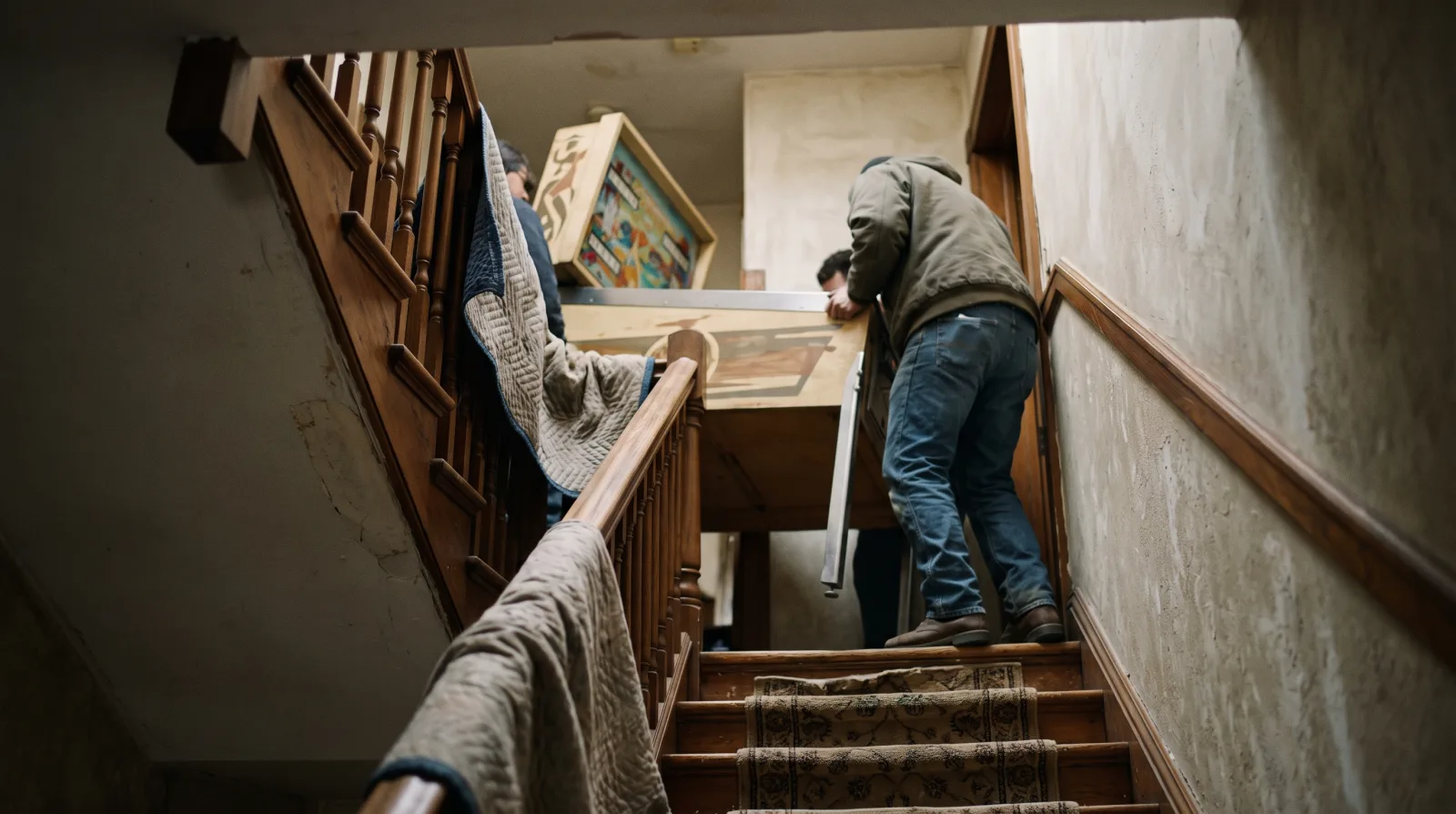
On flat ground, a legless machine on a four-wheel furniture dolly is a one-person push. Stairs are a different animal. Strap the machine to an appliance dolly, keep the heavy transformer end low, put your strongest person on the downhill side, and take stairs one at a time with a third person spotting. Basement stairs in Hudson Valley houses are often narrow, steep, and turn at a landing, so measure the stairwell and the machine before you start, not halfway up. In the vehicle, machines ride flat on their back on blankets, head still folded, never on the face and never standing on end in an open pickup bed. Strap the cabinet so it cannot shift, and put nothing on top of it. A minivan with the seats out, an SUV with a long cargo floor, or an enclosed box truck all work; measure your cargo opening against the cabinet before moving day, because a machine that fits inside a vehicle does not always fit through its door. And give yourself daylight and dry footing, since wet grass and a loaded dolly are a bad combination.
The five mistakes that total machines
- Moving it with the head up. One low doorway or one hard tip and the head tears out its bolts.
- Leaving the balls and glass loose. Loose steel and loose glass in a bouncing cabinet destroy playfields.
- Lifting by the legs. The legs come off the machine, sometimes with pieces of the cabinet still attached.
- Underestimating the stairs. Two people who can lift 300 pounds in a gym cannot always control 300 pounds on a steep, turning basement staircase.
- Standing it on end in a truck bed. The first pothole turns your machine into a domino.
One more honest note: even a perfect move can shake something loose, and a machine that played fine before the trip sometimes will not boot after it. Usually it is a connector or a fuse, nothing dramatic. If your game comes through the move grumpy, our pinball machine repair team works on everything from 1970s Bally games to new Sterns, and this exact situation is one of our most common calls. We move machines constantly ourselves, delivering games from our showroom and hauling rental machines in and out of party venues, so the technique above is not theory, it is Tuesday.
Rather not risk your back, your walls, or the machine?
Reading all this and thinking about your own basement stairs? That is exactly the job we do every week. Tri-State Pinball handles pinball machine removal and pickup across the Hudson Valley and the edges of NJ and PA, basements, tight stairs, and hard access included. In many cases we can haul it away at no cost, and if the machine is worth money we pay you. Call or text Christian at (845) 597-3982 and let the people with the dollies, the straps, and the practice take it from here.