How Much Does a Pinball Machine Weigh? (By Era, With a Moving Checklist)
Published: June 17, 2026 · By Christian Fernandez
Here is the short answer: most full-size pinball machines weigh between 200 and 300 pounds. Older electromechanical games from the 50s, 60s, and 70s usually land near the bottom of that range, and modern widebody machines can push past 350 pounds. That is roughly the weight of a large refrigerator, except a refrigerator does not have a tall backbox trying to tip over on you halfway down the stairs.
I'm Christian, and I run Tri-State Pinball out of Newburgh, NY. I have carried machines out of Hudson Valley basements, attics, barns, and second-floor apartments, so the numbers below come from actually lifting these things, not from guessing.
Pinball Machine Weight by Era
Every machine is a little different, but the era tells you most of what you need to know before you grab an end.
| Era | Years | Typical Weight |
|---|---|---|
| Electromechanical (EM) | 1930s to 1977 | 190 to 250 pounds |
| Early solid state | 1977 to 1985 | 220 to 260 pounds |
| Late solid state and DMD era | 1986 to 1999 | 250 to 300 pounds |
| Modern standard body | 2000 to today | 240 to 280 pounds |
| Widebody and premium LCD era | varies | 300 to 365 pounds |
A few notes on those ranges. EM games from makers like Gottlieb and early Bally are mostly plywood, relays, and a light transformer, which is why two people can usually handle one. The 90s Williams and Bally games that fill so many Hudson Valley game rooms sit in the 250 to 285 pound range. Modern machines from Stern are often a touch lighter than their 90s cousins thanks to newer electronics, while the big LCD-era games from Jersey Jack are the heaviest things I move on a regular basis. If you own one of those, plan like you are moving a piano.
Why Machines Are Heavier Than They Look
The cabinet is thick plywood. The playfield is another slab of wood loaded with metal ramps, coils, wiring, and mechanical assemblies. The tempered glass on top adds real weight of its own, and down in the cabinet sits a transformer that feels like a cinder block. None of that is the real problem, though.
The real problem is balance. A pinball machine with the backbox up is tall and top-heavy, and the weight shifts the moment you tilt it. People do not get hurt because a machine is 280 pounds. They get hurt because 280 pounds suddenly leans the wrong way on a staircase and somebody's back becomes the thing holding it up.
The Moving Checklist
If you are set on moving one yourself, do it in this order. This is the same basic routine we follow on every pinball machine removal we handle.
- Take photos of everything first, especially cable connections inside the backbox.
- Remove the pinballs from the machine. Open the coin door or lift the glass and take them out so they do not slam around in transit.
- Fold down or remove the backbox. Most games hinge forward after you disconnect or unlatch it. This drops the center of gravity and saves your doorframes.
- Remove the lockdown bar and slide the glass out, then wrap it in a moving blanket and carry it separately. Broken playfield glass ruins the whole day.
- Take the legs off with a helper supporting each end, and bag the leg bolts so they do not vanish.
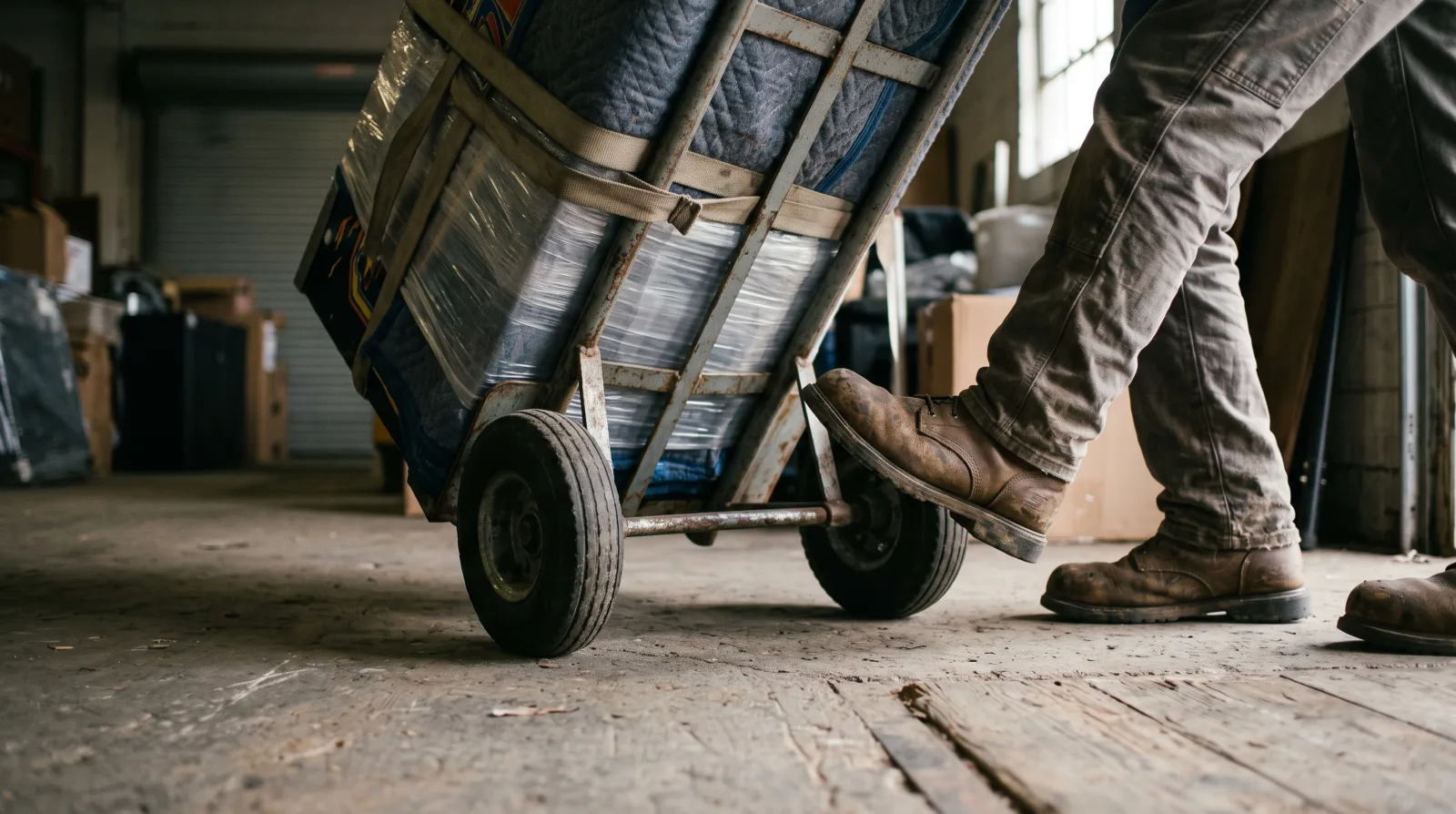
- Strap the cabinet to an appliance dolly, keep it upright when you can, and pad every edge.
- Use two strong adults minimum on flat ground, and three on any staircase.
- In the truck, keep the cabinet flat or on its back on blankets, never on its face, and strap it so it cannot shift.
If any step in that list makes you nervous, that is worth listening to. A dropped machine usually means cracked cabinet corners, a shattered backglass, or boards knocked loose, and at that point you are calling someone for pinball repair anyway.
Stairs and Basements, Where Moves Go Wrong
Around here, the machine is almost never sitting in a garage at ground level. It is in the basement of a 1920s house in Newburgh with a narrow turn at the bottom of the stairs, or a split-level in Wappingers Falls, or a finished basement with carpet the owner would like to keep clean. Basements are where most machines in the Hudson Valley live, and they are also where most moving disasters happen.
Measure the stair width, the ceiling height at the turn, and every doorway on the route before you lift anything. A standard cabinet with the legs off still needs more clearance than people expect, and a widebody needs more again. If the math is tight on paper, it will be tighter in real life with 280 pounds in your hands.
When to Put the Dolly Away and Make a Call
Some moves are honestly fine to do yourself: a lighter EM on a ground floor with a straight shot to the truck. Plenty are not. If the machine has to climb a tight staircase, if you cannot round up enough capable help, or if the game is one of the heavy modern widebodies, bringing in someone who does this every week is cheaper than a chiropractor or a cabinet repair.
That is the bulk of what we do at Tri-State Pinball. We come to you anywhere in the Hudson Valley and the nearby edges of NJ and PA, and we handle the stairs, the truck, and the heavy end. One more thing worth knowing before you wrestle a machine to the curb: some of these games have real value, and we buy machines for cash in any condition, so the thing you are straining to get rid of might actually pay you.
Frequently Asked Questions
Related Guides
Rather not lift it at all? We haul machines out of basements, up tight stairs, and out of anywhere else they are stuck, across the Hudson Valley and the NJ and PA edges. Call or text Christian at (845) 597-3982, or head to our pinball machine removal page for a fast, no-obligation quote.