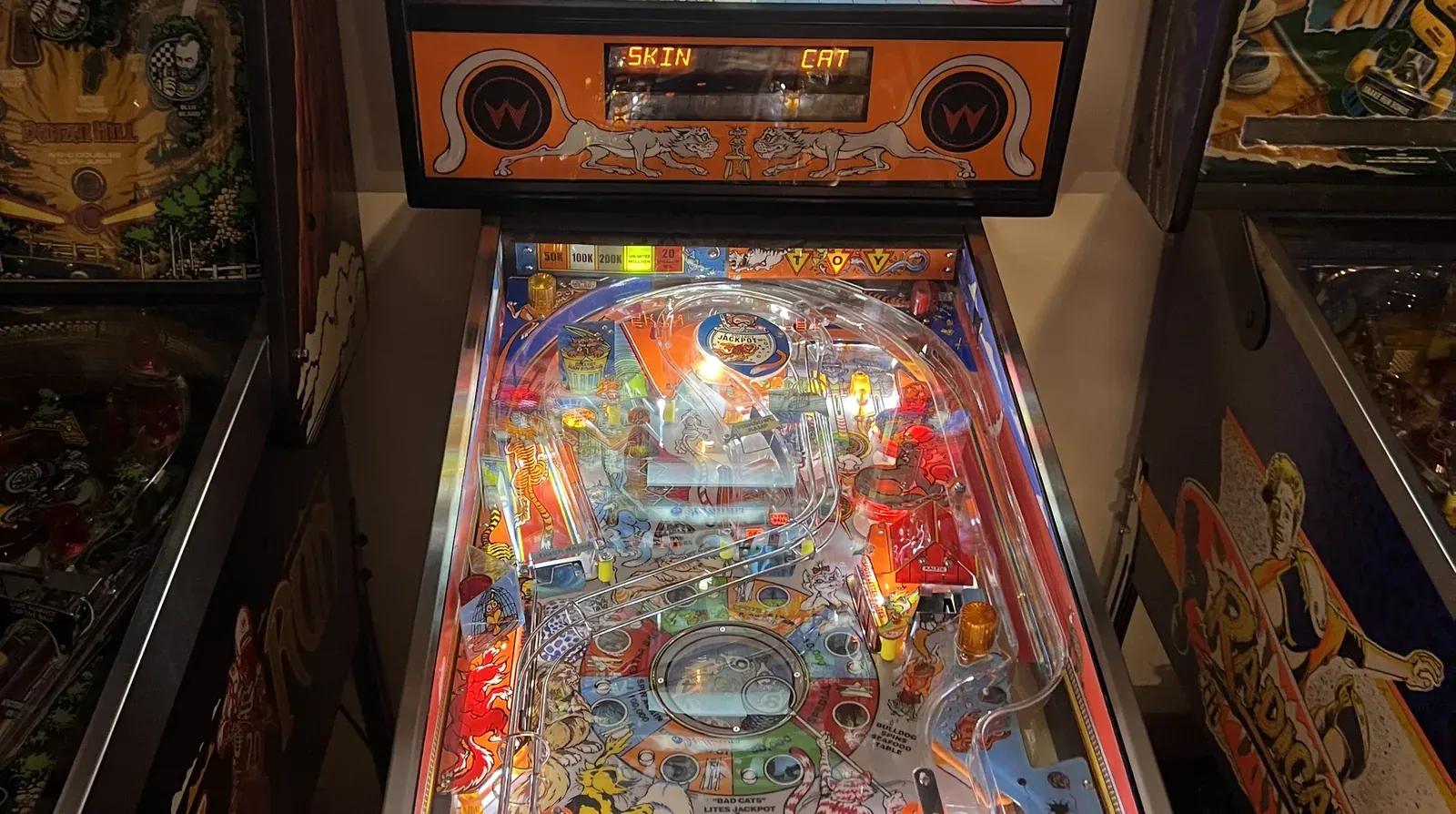
Williams Pinball Machine Repair in the Hudson Valley
Two Golden Ages: System 11 and WPC.
Ask ten Hudson Valley collectors what is in their basement and eight of them will name a Williams game. Tri-State Pinball repairs them in your home. Christian is based in Newburgh, NY and covers Williams pinball repair across a 40-mile radius, the Hudson Valley plus the near edges of New Jersey and Pennsylvania. Whether your Funhouse has a dead DMD or your Whirlwind resets mid-ball, call or text (845) 597-3982 with the symptom and you will get straight pricing and an honest opinion before anyone touches the machine.
Williams owned the late 1980s and the 1990s. The System 11 platform ran from roughly 1986 to 1990 and gave us High Speed, PinBot, F-14 Tomcat, Taxi, Earthshaker, Whirlwind, and Black Knight 2000. Then came WPC, the platform behind the games everyone remembers: Funhouse, The Getaway, Fish Tales, White Water, Star Trek: The Next Generation, and Indiana Jones, followed by the WPC-95 revision that closed out the decade with Attack from Mars, Medieval Madness, Monster Bash, and Cirqus Voltaire.
Here is the detail that trips up owners: many 90s games with Bally on the backglass, The Addams Family, Twilight Zone, Theatre of Magic, Scared Stiff, are Williams WPC machines underneath, because Williams owned Bally by then. If your game is from that list, this is your page, whatever the artwork says. True Bally solid state games from the 70s and 80s are a different animal with their own page.
System 11 Faults We Fix Every Month.
System 11 games are pushing forty, and they fail in familiar patterns. The batteries on the CPU board leak and corrode traces, exactly the way they do on every game of this era, and catching it early saves the board. Bridge rectifiers and connectors in the power chain cook over time, which shows up as blown fuses, flickering lamps, or a game that randomly restarts. Sound sections drop out, leaving a game that plays fine in eerie silence. And the high-current connectors between boards work loose after decades of vibration, causing faults that come and go with a slap on the cabinet.
None of this is exotic. These are known failure points with known fixes, and a System 11 game that has been through them properly will run for years. If your High Speed or Taxi has been limping along, it does not have to.
Flipper Problems, From EOS Switches to Fliptronics.
Weak, sticky, or dead flippers are the number one complaint on 90s Williams games, and the cause depends on the era. System 11 and early WPC games use mechanical flipper circuits with end-of-stroke switches that carry real current. Those switches burn and pit, linkages and coil sleeves wear, and the result is flippers that feel mushy or die mid-game. A proper flipper rebuild, new sleeves, links, plungers, and switch work, transforms how these games play.
From 1992 on, WPC games moved to the Fliptronics system, where optos and a dedicated board control the flippers. Different system, different failures: blown flipper fuses, failed drive transistors, and dirty cabinet-button optos. If both flippers on one side die at once on a mid-90s game, it is very often a single fuse on the Fliptronics board. Christian carries the parts for both flipper systems and rebuilds them in your home.
DMD Displays: Dots Out, Lines Missing, No Display at All.
The dot matrix display defines these games, and it is one of their most common failures. Missing rows or columns of dots usually mean the display glass itself is wearing out. No display at all, or a display that hums and stays dark, usually points to the high voltage section on the driver board, where a handful of resistors and zener diodes fail so predictably that techs replace them as a set.
Both problems are completely fixable. The high voltage section can be rebuilt, worn glass can be replaced, and modern LED replacement displays are available if you want to retire the fragile original technology altogether. What you should not do is keep playing a flickering DMD and hope, because a failing high voltage section can take a good display down with it.
Burned GI Connectors and the Famous WPC Reset.
Open the backbox of a 90s Williams game and look at the connectors along the bottom of the power driver board. On most unrestored games, at least one is browned or half-melted. The general illumination circuits pull heavy current through those pins for thousands of hours, the connections heat up, and the plastic housings scorch. The symptom is GI strings that flicker, cut out when the game warms up, or die entirely. The repair is repinning the connectors and replacing burned header pins with proper parts, not electrical tape and hope.
The same aging power hardware causes the famous WPC reset, where the game reboots itself right as the multiball starts. Tired capacitors, cooked bridge rectifiers, and resistance in old connections drag the 5-volt supply down until the CPU gives up. It feels random. It is not, and it is one of the most satisfying permanent fixes there is.
House Calls for the Games of the 90s.
You should not be hauling a Medieval Madness anywhere. Christian services Williams games where they live: he arrives with flipper parts, connectors, fuses, and display components in the truck, works through the machine in your game room, and play-tests it before he leaves. When a board needs real bench time, the board travels, not your game.
If your machine is fully dead, run through our checklist Pinball Machine Won't Turn On? 7 Fixes Before You Call a Tech first, because a surprising number of dead Williams games are a tripped outlet or a blown line fuse. Details on service and pricing for every brand are on the main pinball repair page. And if the game is rougher than you want to deal with, here is the honest alternative: we buy machines as-is, working or not, so a Williams project you are done with can go through sell your pinball machine instead of sitting broken for another decade.
Frequently Asked Questions
System 11 is the Williams platform from roughly 1986 to 1990, with alphanumeric score displays, and WPC is the 1990s platform with the dot matrix display. They share some habits, like battery corrosion, but their flipper systems, displays, and boards are different, and they are diagnosed differently.
On System 11 and early WPC games it is usually worn end-of-stroke switches, coil sleeves, and linkages. On Fliptronics-era games it can also be a failing drive transistor or a weak connection. A full flipper rebuild fixes the feel in almost every case.
Missing rows or columns usually mean the display glass is failing, so that panel will need replacement. But the high voltage supply on the driver board should be tested at the same time, because a bad supply can damage a new display quickly.
Mid-game resets on 90s Williams machines are almost always a power problem: aging capacitors, bridge rectifiers, or corroded connections letting the 5-volt supply sag under load. It is a well-known fault with a permanent fix.
Yes. The Addams Family, Twilight Zone, Theatre of Magic, and similar titles are Williams WPC machines wearing the Bally name, and we service them exactly like any other WPC game.